
Everyone wants their name or business to pop up at the top of Google. Most people never realize that misaligned or outdated online profiles can seriously damage their digital credibility. The surprising part is that improving your online visibility is more about sharpening your foundation than chasing the latest viral hack. So, do you know how to boost online visibility of your business or personal brand?
Table of Contents
- Step 1: Assess Your Current Online Presence
- Step 2: Identify Your Target Audience And Keywords
- Step 3: Optimize Your Website For Seo
- Step 4: Create And Promote Quality Content
- Step 5: Leverage Social Media Platforms
5 Effective Strategies to Boost Online Visibility
| Key Point | Explanation |
|---|---|
| 1. Conduct a thorough online audit | Evaluate your existing digital presence on various platforms to identify gaps and inconsistencies. |
| 2. Create audience personas | Develop detailed profiles of your ideal audience, considering their needs and preferences, to guide content creation. |
| 3. Focus on SEO and website optimization | Improve your website’s loading speed and content structure to enhance search engine visibility and user engagement. |
| 4. Produce high-quality, diverse content | Create meaningful content that addresses audience pain points using various formats like blogs, videos, and infographics. |
| 5. Engage actively on social media | Build connections by participating in discussions and responding to audience interactions on chosen platforms. |
Step 1: Assess Your Current Online Presence
Launching a successful online visibility strategy begins with a comprehensive assessment of your current digital footprint. This critical first step helps you understand exactly where you stand and provides a strategic foundation for future growth. Your goal is to conduct a thorough evaluation of your existing online presence across multiple digital platforms.
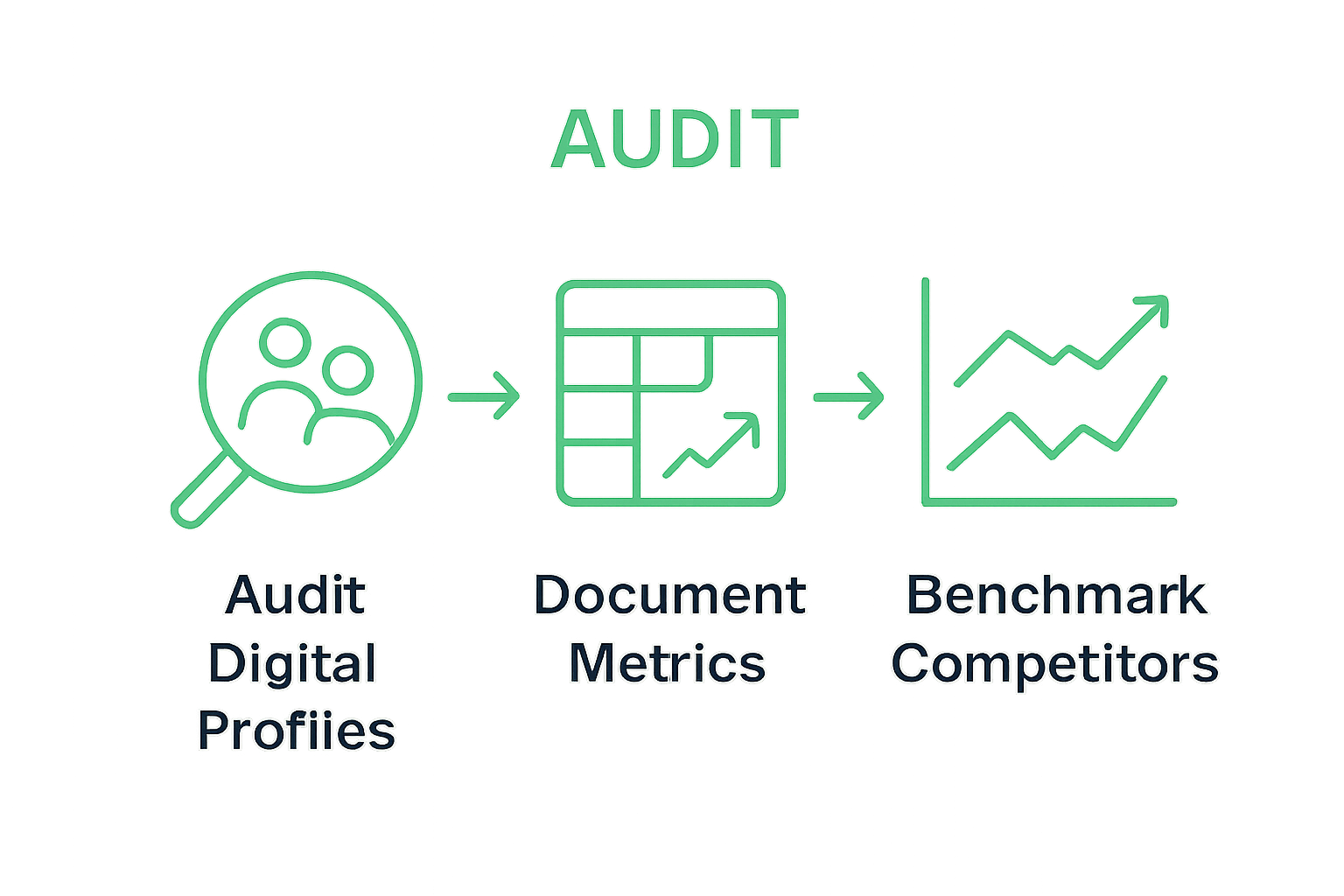
Start by performing a detailed audit of your digital profiles and websites. Google yourself and review the search results meticulously. Check your professional networking profiles like LinkedIn, social media accounts, personal websites, and any public digital content associated with your name or brand. Pay close attention to how you are currently represented online and identify potential gaps or inconsistencies in your digital narrative.
Utilize free tools to help you analyze your online visibility. Google Analytics and Google Search Console offer powerful insights into your website’s performance. These platforms provide detailed metrics about visitor traffic, search rankings, and user engagement. Look for key performance indicators such as page views, bounce rates, average time spent on site, and organic search rankings. These metrics will give you a clear picture of your current online reach and effectiveness.
Documenting your findings is crucial. Create a comprehensive spreadsheet that captures your current digital assets, their performance metrics, and potential areas for improvement. Include columns for each digital platform, current performance stats, strengths, weaknesses, and potential optimization strategies. This systematic approach transforms your assessment from a vague review into a strategic roadmap for enhancing your online visibility.
Pay special attention to content consistency and branding. Ensure that your messaging, visual identity, and professional representation remain uniform across different platforms. Misaligned or outdated online profiles can significantly undermine your digital credibility. If you discover inconsistencies, develop a plan to update and standardize your online presence.
Finally, benchmark your online visibility against competitors or industry leaders. Analyze their digital strategies, content approaches, and engagement levels. This comparative analysis will help you identify opportunities for differentiation and improvement. Explore how strategic branding can improve your online presence and set the stage for your digital growth journey.
A successful assessment provides you with a clear, actionable understanding of your current online landscape, preparing you for the strategic improvements to follow in subsequent steps of boosting your online visibility.
Here is a step overview table summarizing the main actions for boosting online visibility, along with expected outcomes and the focus area for each step.
| Step | Main Action | Expected Outcome | Focus Area |
|---|---|---|---|
| 1 | Audit online presence | Identify gaps, inconsistencies | Assessment |
| 2 | Develop audience personas & keyword research | Clear understanding of target market and keywords | Targeting |
| 3 | Website SEO optimization | Improved search ranking and user experience | Technical/Content |
| 4 | Create & promote quality content | Enhanced authority and engagement | Content Strategy |
| 5 | Leverage social media platforms | Broader reach, more engagement | Social Engagement |
Step 2: Identify Your Target Audience and Keywords
The foundation of successful online visibility lies in understanding precisely who you want to reach and how they search for information. This critical step transforms your digital strategy from a generic approach to a targeted, precision-driven campaign that connects directly with your ideal audience.
Begin by developing a comprehensive audience persona that goes beyond basic demographics. Consider not just age and location, but the deeper psychological aspects of your potential customers. What are their professional challenges? What solutions are they seeking? What language do they use when discussing their needs? These insights will help you craft content that resonates authentically with your target market.
Keyword research becomes your strategic compass in this journey. Utilize powerful tools like Google Keyword Planner and SEMrush to uncover the specific search terms your audience uses. Look for keywords that balance search volume with realistic competition levels. Long-tail keywords with specific intent often provide more valuable traffic than broad, highly competitive terms. For instance, instead of targeting a generic term like “digital marketing,” focus on more specific phrases like “affordable SEO services for small businesses” that demonstrate clear user intent.
Develop a keyword mapping strategy that connects audience needs with your content offerings. Create a spreadsheet that categorizes keywords by search intent, difficulty, and potential relevance to your specific services or products. This systematic approach transforms keyword research from a random activity into a strategic planning tool. Group keywords into clusters that represent different stages of user journey awareness, consideration, and decision making.
Validate your research by testing these keywords in real-world scenarios. Use Google Search Console to track how these terms perform, monitoring impressions, click-through rates, and actual user engagement. Pay attention to the language your actual audience uses in comments, reviews, and social media interactions these organic conversations often reveal keyword opportunities you might have missed.
Learn how to integrate SEO strategies effectively into your digital marketing approach to maximize the impact of your keyword research. Remember that audience identification and keyword selection are not one-time activities but ongoing processes that require continuous refinement and adaptation to changing market dynamics.
A successful keyword and audience identification process provides you with a clear roadmap for creating targeted, engaging content that speaks directly to the people most likely to be interested in your offerings.
Step 3: Optimize Your Website for SEO
Website optimization represents the critical bridge between identifying your audience and actually connecting with them through search engines. This step transforms your digital presence from invisible to discoverable, ensuring that search engines can easily understand and rank your content.
Start by focusing on technical fundamentals that form the backbone of search engine optimization. Page loading speed is a critical ranking factor that directly impacts user experience and search engine performance. Use tools like Google PageSpeed Insights to analyze and improve your website’s performance. Compress images, minimize unnecessary code, leverage browser caching, and consider using content delivery networks to accelerate your site’s loading times. Remember that even a few seconds of delay can significantly reduce user engagement and search rankings.
Content optimization requires a strategic approach that balances human readability with search engine requirements. Craft high-quality, original content that naturally incorporates your researched keywords. Strategically place primary keywords in critical areas like page titles, meta descriptions, headers, and the first paragraph of your content. However, avoid keyword stuffing; search engines penalize content that appears artificially manipulated. Instead, focus on creating informative, valuable content that genuinely addresses your audience’s needs and questions.
Structure your website with clear, logical navigation that helps both users and search engine crawlers understand your content hierarchy. Implement internal linking strategies that connect related content, helping visitors and search algorithms discover more of your valuable information. Use descriptive, keyword-rich anchor texts for these internal links to provide additional context. Ensure your website’s architecture is clean, intuitive, and allows seamless navigation across different devices and screen sizes.
Technical SEO elements require meticulous attention. Generate an XML sitemap that helps search engines comprehend your website’s structure. Implement schema markup to provide additional context about your content. Verify that your website is mobile-responsive, as Google primarily uses mobile-first indexing. Check that all pages have unique, descriptive meta titles and descriptions that accurately represent the content while enticing users to click.
Learn advanced techniques for maximizing your on-page SEO elements to further refine your optimization strategy. Continuously monitor your website’s performance using tools like Google Search Console, tracking key metrics such as organic search traffic, click-through rates, and search rankings.
Successful SEO optimization creates a robust digital foundation that dramatically improves your online visibility, setting the stage for increased organic traffic and audience engagement.

Step 4: Create and Promote Quality Content
Content creation represents the heart of your online visibility strategy, transforming your digital presence from passive to powerfully engaging. This step is about crafting meaningful, valuable content that not only attracts your target audience but also establishes your authority and expertise in your chosen field.
High-quality content begins with deep understanding of your audience’s genuine needs and pain points. Move beyond surface-level information and develop content that provides actionable insights, solves specific problems, and offers unique perspectives. Research thoroughly and draw from your professional experience to create original, compelling narratives that stand out in a crowded digital landscape. Aim to answer the questions your audience is actively searching for, using the keyword research you completed in previous steps to guide your content strategy.
Diversity in content format is crucial for maintaining audience engagement. While written blog posts remain essential, incorporate multiple content types such as videos, infographics, podcasts, and interactive guides. Each format offers different ways to communicate complex information and caters to varying audience preferences. Use professional tools like Canva for creating visually appealing graphics, or platforms like Loom for generating video content that explains complex concepts quickly and effectively.
Content promotion is equally important as content creation. Develop a strategic distribution plan that extends beyond simply publishing on your website. Leverage social media platforms, professional networks like LinkedIn, and relevant online communities to share your content. Engage with your audience by responding to comments, participating in discussions, and creating content that encourages interaction. Consider using email newsletters to distribute your most valuable content directly to interested subscribers, creating a consistent touchpoint with your audience.
Consistency and quality must be your primary metrics. Establish a content calendar that helps you plan and schedule content systematically. This approach ensures regular publication and helps you maintain a steady stream of valuable information. Use analytics tools to track content performance, understanding which pieces resonate most with your audience and why. Pay attention to metrics like engagement rates, time spent on page, and social shares to continually refine your content strategy.
Explore innovative content strategies that can transform your SEO approach and help you develop more compelling, targeted content. Remember that content creation is an ongoing process of learning, adapting, and improving.
Successful content creation and promotion build a robust digital presence that attracts, engages, and converts your target audience, establishing you as a trusted voice in your professional domain.
Step 5: Leverage Social Media Platforms
Social media platforms are powerful amplification tools that can dramatically extend your online visibility beyond traditional website boundaries. This step transforms your digital strategy from static content distribution to dynamic, interactive audience engagement that builds genuine connections and expands your professional network.
Strategic platform selection matters more than volume. Instead of attempting to maintain a presence on every social network, focus on platforms where your target audience naturally congregates. LinkedIn offers exceptional professional networking opportunities, Twitter provides rapid information sharing, and Instagram allows visual storytelling. Analyze each platform’s demographic composition and align your chosen channels with the specific audience characteristics you identified in earlier steps.
Develop a consistent brand voice that remains authentic across different social media channels. This means creating platform-specific content that maintains your core messaging while adapting to each platform’s unique communication style. On LinkedIn, share professional insights and industry analysis. For Twitter, craft concise, impactful statements. Instagram demands visually compelling content that tells your professional story through images and short videos. Use scheduling tools like Hootsuite or Buffer to maintain regular posting frequencies without constant manual intervention.
Engagement is the cornerstone of social media success. Passive broadcasting will not generate meaningful connections. Actively participate in discussions, respond to comments, and contribute valuable perspectives in professional groups and forums. Comment on other professionals’ posts, share insightful articles, and create content that invites interaction. Treat social media as a two-way conversation rather than a one-way announcement platform.
Track your social media performance using native analytics tools provided by each platform. Monitor key metrics such as engagement rates, follower growth, post reach, and click-through rates.
The following table organizes the essential free and paid tools mentioned in the article for assessing and improving online visibility, including their main purpose to help you decide which to use.
| Tool | Free or Paid | Primary Purpose |
|---|---|---|
| Google Analytics | Free | Track website traffic and user behavior |
| Google Search Console | Free | Monitor search rankings and site performance |
| Google Keyword Planner | Free | Identify keyword search volumes and trends |
| SEMrush | Paid | Advanced keyword research and competitor analysis |
| Google PageSpeed Insights | Free | Analyze and improve website loading speed |
| Canva | Free/Paid | Create visual content and infographics |
| Hootsuite/Buffer | Paid | Social media scheduling and management |
| Loom | Free/Paid | Record and share video content |
Learn innovative strategies for building your personal brand quickly and effectively, and learn how to maximize your social media potential. Remember that social media success is a marathon, not a sprint. Consistent, genuine engagement yields the most significant long-term results.
Successful social media leveraging creates a dynamic, interactive online presence that attracts opportunities, builds professional credibility, and significantly enhances your digital visibility.
Ready to Make Your Online Growth Real?
You have just learned proven strategies for building your online visibility, but turning these steps into real business results can feel overwhelming. Whether you struggle with inconsistent branding, low website traffic, or content that fails to connect with your ideal audience, these are challenges you do not have to face alone. If you are looking to finally see measurable growth, targeted engagement, and stronger credibility online, now is the time for expert help. Explore how Sayed Sayeedur Rahman, a trusted SEO specialist and digital marketing consultant, can guide your transformation from invisible to impactful online presence.
Take the proven methods from “How to Boost Online Visibility: Effective Strategies for Growth” and turn them into a clear action plan for your business. See real-life results from clients who have elevated their online brands, streamlined their content, and achieved powerful search rankings. Visit the portfolio and consulting page to learn more or book a discovery call now to secure your spot. Start building the authority and reach your business deserves. Do not wait for opportunities to pass by. Take control of your digital future today.
Frequently Asked Questions
How can I assess my current online presence?
To assess your online presence, perform a detailed audit of your digital profiles across platforms like LinkedIn, social media, and personal websites. Use tools like Google Analytics and Google Search Console to evaluate website performance metrics such as traffic, search rankings, and user engagement.
What are effective ways to identify my target audience?
Develop a comprehensive audience persona that includes demographics and psychographics. Research their professional challenges, needs, and the language they use when discussing these issues, which will help in crafting resonant content.
What strategies can I use to optimize my website for SEO?
Optimize your website by improving page loading speed, crafting high-quality content with relevant keywords, and ensuring clean navigation. Implement technical SEO practices such as XML sitemaps and mobile responsiveness to enhance discoverability.
How important is quality content in boosting online visibility?
Quality content is crucial as it establishes authority and addresses audience needs. Create diverse content types, promote them strategically on various platforms, and maintain a consistent posting schedule for maximum engagement.

Sayed Sayeedur Rahman is a professional SEO specialist and content writer. He has extensive 6 years of professional experience in consulting for USA, Australia, and UK-based companies to grow their businesses online. He is the co-founder of TechLookBD, which was recognized by the MarTech Awards as 2024’s most pioneering SEO strategy company. Sayeed has also been featured on WriterZen for his proven SEO achievements.